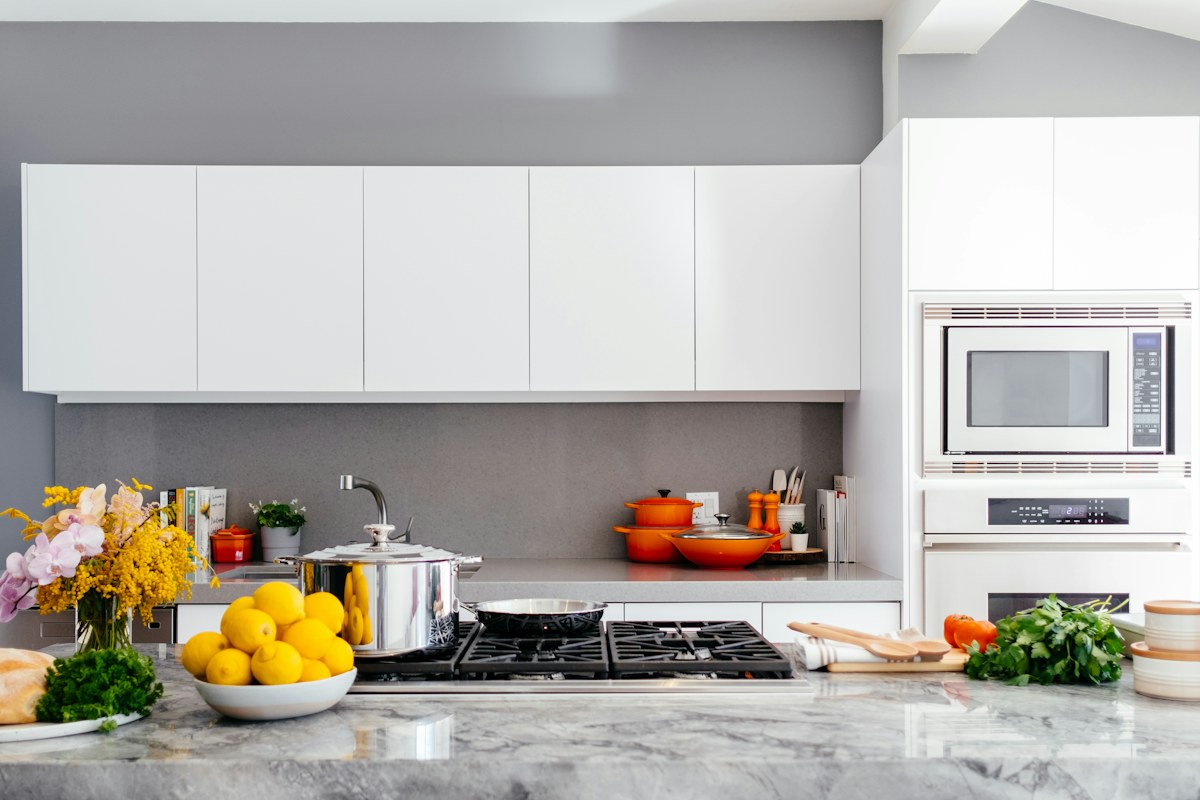
A kitchen counter can be technically spacious and still offer nowhere to put down the thing in your hands. Shopping bags, post, appliances and decorative pieces gradually occupy the useful areas until every small task begins with moving something else. Choose one landing surface and give it a clear daily role. It should support a recurring action such as putting down a grocery bag or assembling ingredients, rather than remain empty merely to satisfy an image of a tidy kitchen.
Pick the action before the location
Think about the moment that most often feels awkward. You may arrive carrying a bag, take ingredients from a cupboard or need a place for a clean bowl. Choose one of those actions and follow its route through the kitchen. The most convenient surface may not be the largest. It should be close enough to the task to be useful while respecting the appliances, fittings and working arrangements around it. Follow the kitchen equipment's intended clearances and instructions rather than using a convenient gap without considering its purpose.
Remove unrelated permanent residents
Look at what currently occupies the chosen surface. Separate things genuinely used there from objects that settled because they had no destination. Move only the latter first. An appliance you use every morning may deserve its position, while unopened post or an occasional serving dish may belong elsewhere. Avoid clearing the counter by transferring everything into one drawer. Each moved object needs an appropriate place or a clear next decision, otherwise the landing area will refill as soon as normal life resumes.
Define what may arrive temporarily
A landing surface is not a promise that nothing will ever sit there. Decide what belongs briefly and what should never become part of the area. For example, a shopping bag can arrive while its contents are put away, then leave. Keys may need a different return point so they do not mix with preparation tasks. Keep the rules ordinary and understandable to everyone using the kitchen. A purpose people recognise is more useful than a boundary enforced only by the person who first cleared it.
Preserve the surface's practical use
Check the material's care instructions and use appropriate protection for the items placed on it. Do not assume a countertop tolerates every cleaning product, hot object or wet container. Keep the area suitable for its intended task through the normal care routine. If it serves food preparation, follow appropriate hygiene guidance and keep unrelated belongings away during that use. The goal is a usable surface, not simply a visually empty one. Cleanliness, condition and access all contribute to whether the space can do its job.
Give temporary items an exit
Choose what happens after the landing action. Shopping bags can return to their storage place, a bowl can move into the meal preparation and papers can go to the place where they are handled. Make that next step close enough to be realistic. If the exit requires opening several cupboards or rearranging another crowded area, improve that destination rather than repeatedly clearing the counter by force. Clutter often returns because the next useful place is difficult to use, not because the landing area lacks another organiser.
Coordinate with shared routines
Ask other household members how they use the kitchen at the same times. One person's ideal landing surface may be another's essential preparation area. Agree how the space changes roles and how it is left ready for the next person. Avoid solving the conflict with a permanent tray that simply divides an already small counter into less useful pieces. Sometimes a different arrival point outside the kitchen is the better answer. The arrangement should make shared activity easier rather than assign everyone a new obstacle to work around.
Test through an ordinary busy day
Use the area without styling it specially and notice what accumulates. If the same object repeatedly returns, find out why. Perhaps its supposed storage is too far away, or the landing surface is being asked to perform two incompatible tasks. Adjust one point at a time. There is no need to redesign the entire kitchen because the first choice was imperfect. A small clear area that works consistently is more valuable than a fully empty counter that survives only until the next grocery trip.
Keep the reset proportionate
At the end of the relevant task, remove what has finished its temporary role and leave the surface appropriately clean and ready. Do not turn that reset into a full kitchen overhaul every time. If the arrangement begins to fail, return to the original action and check whether it still reflects daily life. A useful landing surface earns its space by reducing the first awkward moment of a task. It should be easy to maintain because its purpose is clear, not because someone constantly polices it.
Continue the practical edit
Related reading: A Temporary Working Row for Kitchen Bottles, Making a Clear Landing Space for Fresh Herb Preparation.
Editorial & photography notes
Practical editorial guidance for ordinary situations. This article does not claim product testing or report current offers. Follow the relevant maker’s instructions for the items you use.
Illustrative stock photograph by Jason Briscoe: photo source. This scene does not identify our author or establish a product test.