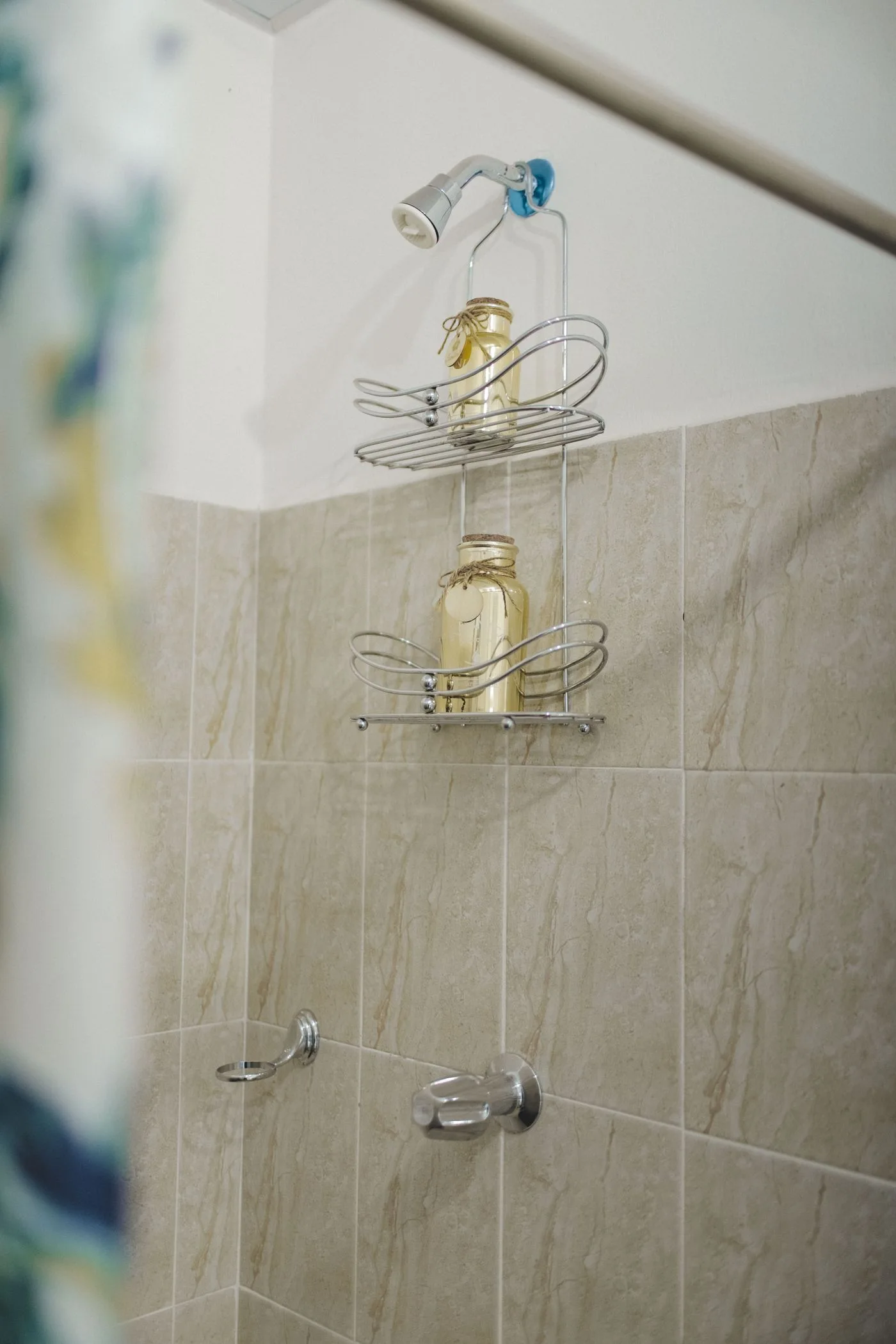
A shower shelf can look spacious while failing to hold the products used every morning. A tall bottle may fit only with its cap closed, a pump may need more room above it, or the item used most often may sit behind a jar that has to be moved first. Before choosing another caddy, gather the actual containers and name the small group that belongs in the shower. The useful brief includes retrieval, opening and return, not merely the dimensions of bottles lined up neatly on an empty shelf.
Separate the current shower group from the reserve
Identify the products actually used in that location. Keep unopened reserves and items belonging to another routine in suitable storage according to their instructions. A shower caddy does not need to contain every bathroom product the household owns, and additional capacity can make the working group harder to understand rather than easier.
If several people share the space, agree on a simple distinction that reflects real use. This might be a clear position for each person's current items, where the storage design permits it. Avoid making a complicated system that depends on everyone remembering the meaning of several matching unlabeled containers.
Measure the bottle in its working form
Compare the dimensions of the actual container with the storage opening. Include a pump in its intended operating position, a flip cap when open and any other movement needed for normal use. A closed bottle's height alone may not establish whether the product can be used conveniently while standing on the shelf.
Keep the container's own instructions in view. Some products should be removed before use, while another may be designed for a particular dispensing position. Do not assume that a bottle shown upright in a photograph can be stored, inverted or operated in any arrangement that happens to fit the caddy.
Check the shelf's intended use first
Read the storage product's guidance for suitable installation, surfaces, loading and use in the intended environment. A decorative basket or a shelf designed for another room should not automatically become shower storage. Where the mounting method or supporting surface is uncertain, obtain appropriate product or installation advice before putting the item into service.
Use the actual maker's instructions for the actual product. IKEA's official guidance on finding assembly information is a useful example of locating instructions through a product page, but it does not establish the requirements of an unrelated shelf. Do not improvise a fitting or ignore an unclear requirement to make a preferred design work.
Compare the base and retaining edges
Look at how the container rests on the intended shelf surface. A narrow base, an irregular shape or a gap between supports can make the fit different from the nominal shelf width. Follow the storage product's guidance rather than adding an improvised platform or liner whose suitability has not been established.
Check whether the retaining edge interferes with removal or return. A high edge may suit one container and make another awkward to lift. The answer can be a different position, a different appropriate storage product or a smaller working group. It should not depend on balancing a container where it does not rest as intended.
Make retrieval an ordinary movement
Assess access in an appropriate setting with the product installed and used as instructed. Notice whether reaching for one item requires moving several others or whether a cap becomes hidden behind a taller container. Keep access comfortable for the actual users and avoid relying on an awkward reach that only seemed manageable during a brief dry inspection.
Choose an arrangement with clear return positions. When a bottle has no obvious place, it is more likely to migrate to another surface and make the shower area harder to use. A modest amount of spare working room may be more valuable than filling every section to its apparent capacity.
Include cleaning and product changes
Read the care information for the shelf and the items it holds. Consider how the storage can be cleaned appropriately and how containers can be removed for that task. A visually neat fixed arrangement may become inconvenient if ordinary care requires disassembling a crowded group every time.
Allow for a realistic replacement bottle without assuming every future container will have exactly the same shape. You do not need unlimited spare space, but a storage system chosen around one unusually narrow bottle may be less useful when the household changes a product. Compare the dimensions of actual likely replacements rather than imagined maximum capacity.
Decide what problem the purchase is solving
Write a short brief before ordering: the current working group, its relevant dimensions, the required opening movements and the product's installation and care requirements. This is more useful than a search for the largest or most decorative shelf. If the present storage becomes workable after removing reserves, a new purchase may not be necessary.
Does a closed bottle fitting on a shelf prove usability? No; opening and retrieval still matter. Can any basket be used in a shower? Only where its intended use and instructions support that setting. Should every product be decanted to make it fit? Do not change storage without understanding the product's requirements and retaining necessary information. Choose shower storage that serves the real routine with clear access and appropriate use.
Continue the practical edit
Related reading: A Beauty Routine That Fits a Small Counter, A Guest-Ready Home Without a Guest Room.
Sources & further reading
Official information checked October 15, 2026. This guide presents research-based editorial advice, not a claim of hands-on product testing. Event details and stock information reflect that check date.
Illustrative stock photograph by Stock photographer: photo source. This scene does not identify our author or establish a product test.