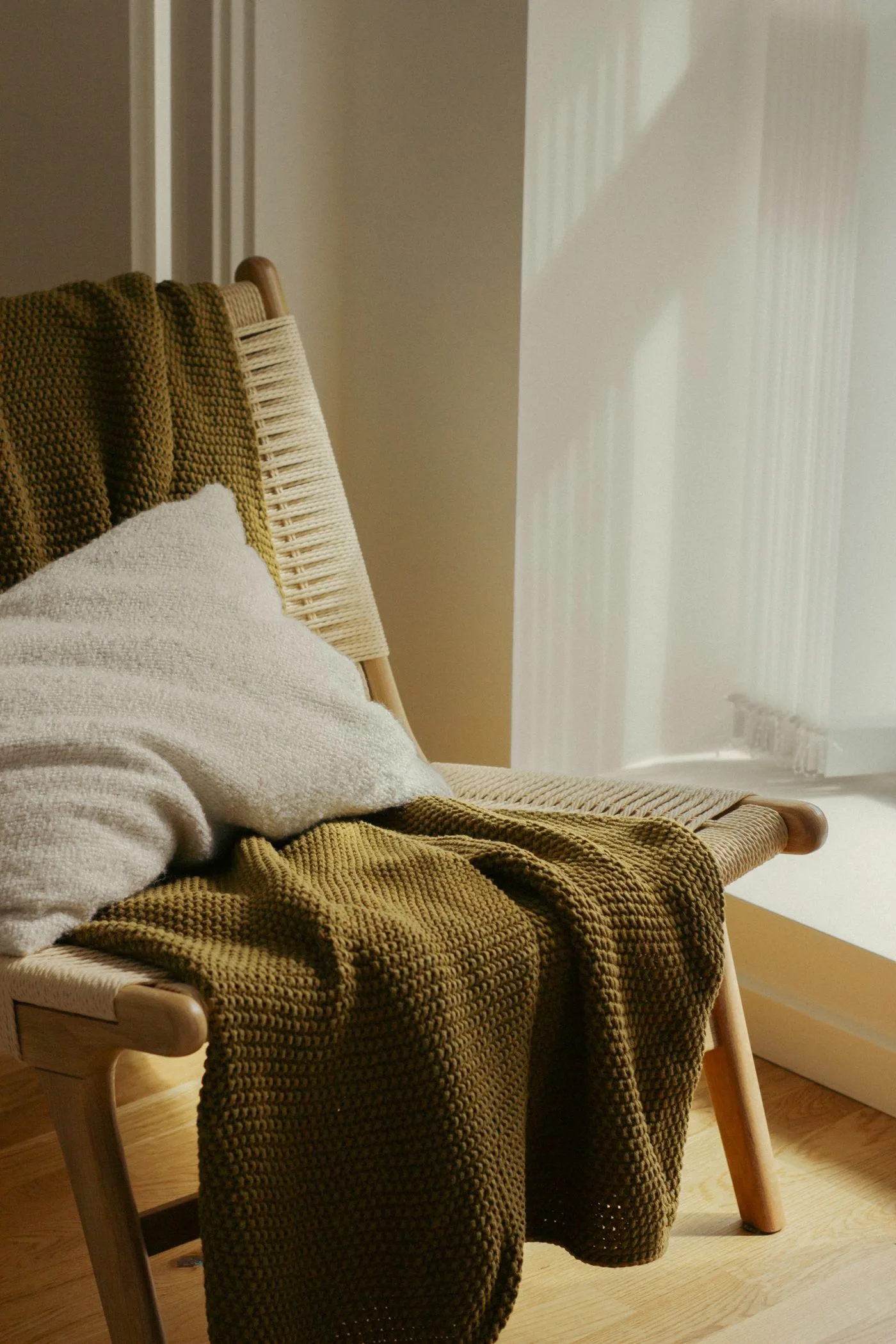
A throw arranged across an armchair can make a room look welcoming while becoming the first thing removed whenever someone sits down. It may slide under the seat, hide the chair's comfortable position or end up on the floor because there is no convenient place to return it. Decide whether the throw is mainly decorative, regularly used or both. Then arrange it around the chair's ordinary job. The useful result is a small comfort that can be reached and put away without rebuilding a display after every evening.
Start with the chair without the throw
Sit in the chair as you normally would and notice which parts of the seat, arms and back you use. Check the chair's own instructions and intended use where relevant. This establishes a starting point before a cushion or folded textile changes how the space is occupied.
Identify any movement that belongs to the chair's design. A reclining or adjustable chair needs an arrangement suitable for that mechanism and its instructions. Do not assume that a textile can be tucked into any gap merely because the gap is hidden from the front. The throw should fit the chair's use, rather than interrupting a feature you chose the chair to provide.
Decide how often the throw is actually used
Think about the ordinary sitting routine rather than an imagined ideal evening. If the throw is used most times the chair is occupied, it needs an accessible place. If it is only occasional, suitable nearby storage may make more sense than covering the seat permanently.
Keep the role specific. A decorative textile can be enjoyed as decoration, but it does not have to pretend to be a practical blanket for every person. Likewise, a frequently used throw does not need a complicated drape to justify being in the room. Naming its role makes the next arrangement easier to choose.
Compare a fold with a loose arrangement
Try a simple appropriate fold and observe how much of the chair it occupies. A folded throw can be easier to return consistently, while a looser arrangement may be easier to lift into use. Compare the actual textile and chair rather than expecting a photographed fold to work with a different size or fabric weight.
Avoid forcing a bulky throw into a narrow space just to make the front of the chair look clear. If the textile takes over the seat or arm, a different suitable position may be more useful. You may already own a lighter or smaller item that fits the chair's role better, without needing to buy another piece for the room.
Give the return movement equal attention
Use the throw as intended, then put it back in the chosen place. Notice whether the arrangement can be restored with a simple movement or requires several careful stages. A display that works only while nobody uses the chair may not suit a busy household.
Try the return from the position in which you normally finish using it. If you have to carry the throw across the room or move other objects to make space, simplify the destination. A clear suitable place nearby can be enough. The aim is to make the ordinary end of the activity as straightforward as the beginning.
Keep cushions and the throw from competing
Add only the cushions that are useful or welcome when the chair is occupied. A chair can hold an attractive group of textiles and still leave too little space for comfortable sitting. Compare the arrangement with the actual person and activity in mind, rather than measuring success by the number of objects included.
If a cushion is always removed, decide where it belongs during use and whether it needs to remain on the chair at all. A nearby suitable destination is better than an object repeatedly placed wherever there happens to be a spare surface. The throw should not become a cover for another unresolved storage decision.
Consider contact and care information
Read the relevant care information for both textile and chair. Different materials and finishes may require different handling, and appearance alone cannot establish a suitable cleaning method. Avoid adding an improvised attachment or liner without understanding its suitability for the actual surfaces involved.
Keep the throw's care needs realistic for its role. A regularly used item needs an appropriate route through the household's normal care routine. If a delicate textile is mainly decorative, choose that role deliberately rather than expecting it to behave like an easy-care everyday blanket. The room can include different textiles without pretending they all require the same attention.
Check the surrounding route after use
Stand from the chair and look at where the throw ends up. Keep the normal route around the chair clear and use a position appropriate to the room and chair design. If the textile regularly drops into that route, revise the fold, destination or choice of throw instead of accepting the same adjustment every time.
Must a throw cover the chair back? No; choose a suitable position for actual use. Does a matching cushion make it more practical? Only if the combined arrangement works when someone sits down. Is a storage basket essential? Not if an existing appropriate location solves the task. A useful armchair throw belongs to an understandable routine: easy to reach, pleasant to use and simple to return.
Continue the practical edit
Related reading: A Reading Ritual for an Ordinary Busy Evening, Mix Sofa Textiles Without a Full Room Makeover.
Sources & further reading
Official information checked October 15, 2026. This guide presents research-based editorial advice, not a claim of hands-on product testing. Event details and stock information reflect that check date.
Illustrative stock photograph by Stock photographer: photo source. This scene does not identify our author or establish a product test.