
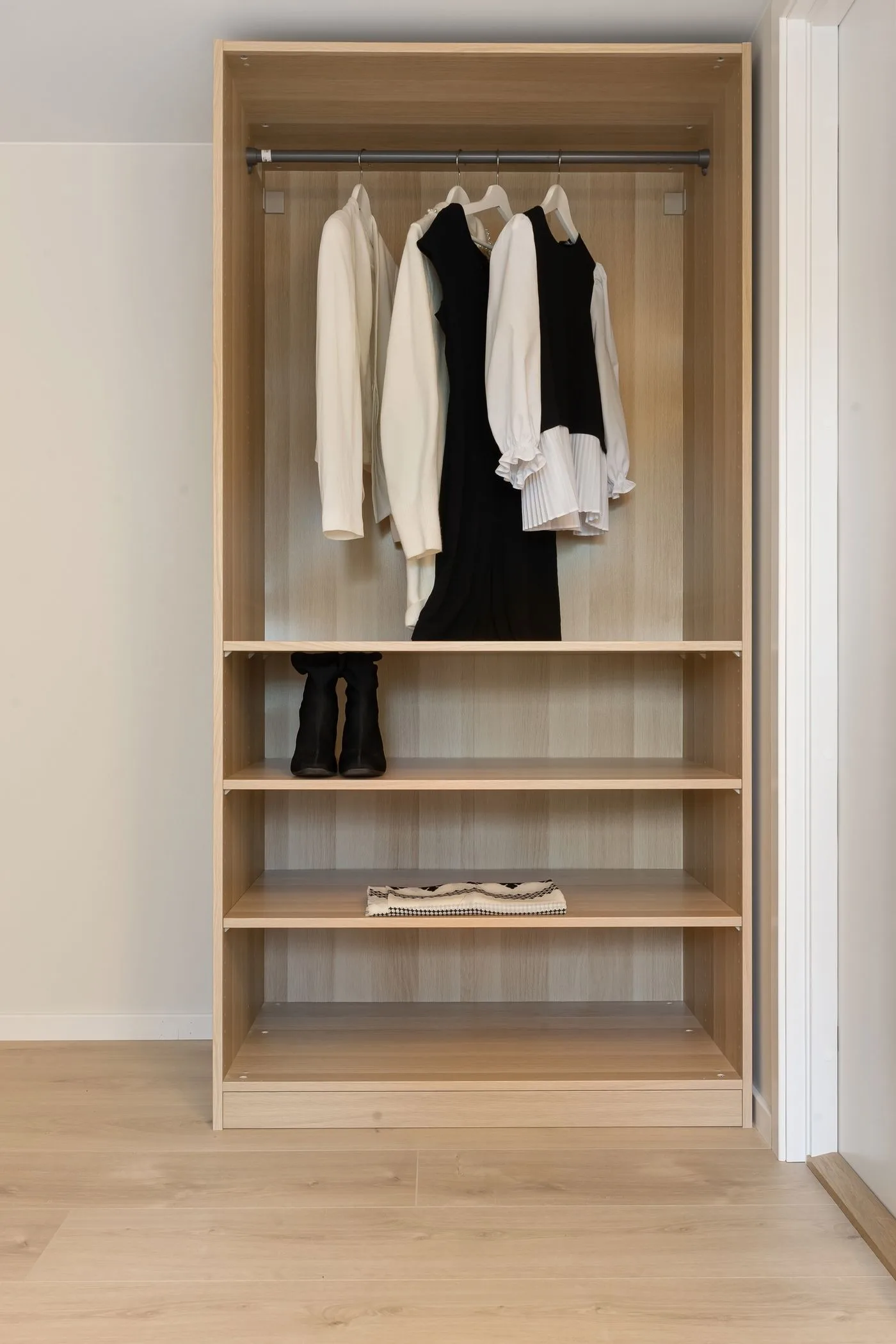
A shared wardrobe is not simply a larger version of a personal cupboard. Two people may use it at different times, store different kinds of clothing and have different preferences about what remains visible. Buying matching organisers does not resolve those differences. Begin with an agreement about how the space will work, then decide whether any accessory is needed. A useful arrangement makes ordinary access easier while respecting that the clothes and decisions belong to their owners.
Ask each person to describe the routine
Discuss when the wardrobe is usually opened, what each person retrieves most often and which items need a particular storage method. Include work patterns, occasional clothing and the way clean laundry returns to the space. Avoid deciding that one person's routine is normal and the other's is the exception. The available furniture has to support the actual household, not an idealised pair of identical wardrobes.
Keep the conversation specific. One person may need to retrieve a shirt before the other wakes, while another may use a shelf for folded pieces that should not be hung. Follow the garments' care guidance and the furniture's instructions. Do not impose a storage method solely to create matching visual sections if it is unsuitable for the items or makes an ordinary routine harder.
Map usable space rather than dividing by appearance
Look at hanging height, shelf access and the way doors or drawers open. An equal-looking vertical division may not provide equivalent usable space. A high shelf can be less convenient for one person, and a low hanging area may not suit longer garments. Discuss the relationships that matter rather than treating a symmetrical photograph as proof that the allocation is fair.
If the furniture needs adjustment, follow its supported configuration and loading instructions. Do not remove structural pieces, improvise additional rails or assume that a shelf can carry whatever fits on it. Where a suitable arrangement cannot be achieved safely with the existing furniture, recognise that limit. An agreement about use should not depend on an unapproved modification.
Make ownership understandable
Choose a simple way to recognise each person's ordinary area. It may be enough to use separate sections without labels, or a shared shelf may need a clear boundary. Ask what both people can remember easily. A system that requires one person to explain every folded pile is not yet a shared arrangement, even if that person finds it intuitive.
Agree what happens to genuinely shared items and anything borrowed. A shared garment does not necessarily mean either person can lend it elsewhere or change its care routine without discussion. If ownership is unclear, resolve the question before reorganising the item. Do not use a wardrobe tidy as an opportunity to dispose of, donate or relocate another person's belongings without their agreement.
Plan the return of clean clothing
Decide whether each person puts away their own laundry or whether one person sometimes handles both. If someone else will return clothes, the arrangement needs to be understandable to them too. Give uncertain items a suitable temporary place and ask, rather than hiding them in an arbitrary drawer to finish the task. A quick question can prevent repeated searching later.
The guide to a small-home laundry system offers a related way to examine handovers. Keep the wardrobe agreement connected to that real route. If clean clothes consistently collect outside the cupboard, find out whether the difficulty is access, insufficient suitable space or an arrangement that no longer matches what people wear.
Leave room for changing needs
A fixed division may work well, but occasional flexibility can be useful when clothing needs change. Discuss how temporary extra space will be requested and when it will be reviewed. Do not quietly fill someone else's area because it appears unused. Empty space can be intentional, and a person may need it for an item currently being worn or cleaned.
Avoid storing future hypothetical purchases at the expense of present access. Equally, do not require a person to justify every item they own simply to retain an agreed section. The purpose is to make a practical arrangement both people accept. A shared wardrobe does not require shared taste, identical shopping habits or a common definition of the perfect clothing collection.
Buy an organiser only for a defined task
Once the arrangement has been tried, identify any specific problem an accessory would solve. A divider may keep a suitable folded group distinct, while a box may make a particular category easier to retrieve. Check actual dimensions, access and the item's suitability before buying. An organiser that consumes the needed clearance or hides ownership can make a simple agreement more difficult.
The guide to organising before buying storage offers a broader framework. Keep the final shared arrangement modest enough that both people can maintain it. Review it when something stops working, explain a proposed change before making it and retain the parts that already support ordinary use. A successful shared wardrobe is one people can use confidently, even when its two sides look different.
Editorial & photography notes
Practical editorial guidance for ordinary situations. This article does not claim product testing or report current offers. Follow the relevant maker’s instructions for the items you use.
Illustrative stock photograph by Lisa Anna / Pexels: photo source. This scene does not identify our author or establish a product test.