
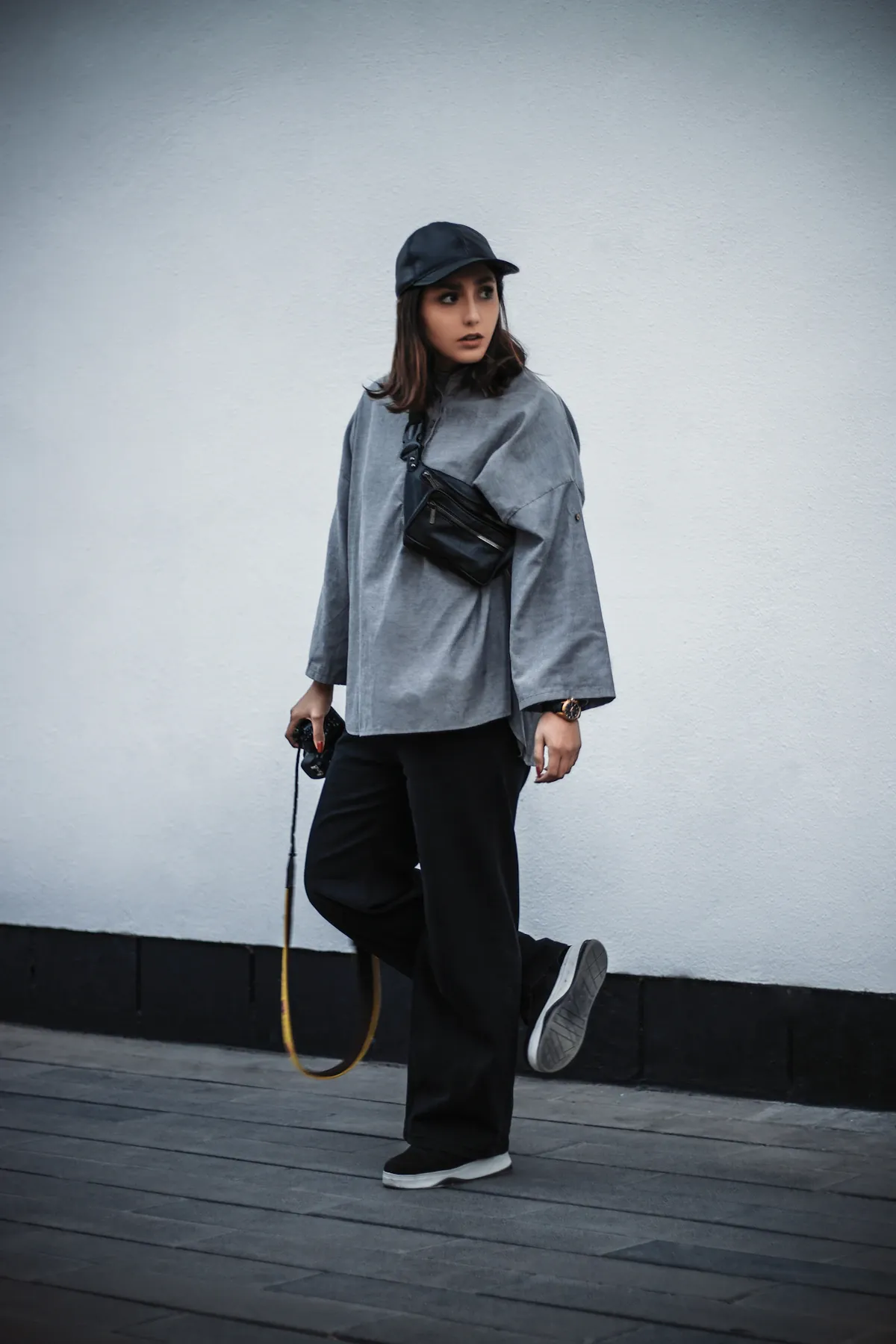
Tailored trousers do not need a matching jacket to earn a place in an ordinary wardrobe. A simple top can make them useful for a day that includes a desk, a walk and an informal meeting. The challenge is usually the relationship between shapes: a soft top may pool over a waistband, or a narrow top may make wide trousers feel more dramatic than intended. Start with the trousers you already like and change one part of the outfit at a time, so you can identify what makes the combination comfortable and convincing.
Give the trousers a clear starting point
Choose a pair that is ready to wear with the shoes you intend to use. Fasten the waistband normally, empty bulky pockets and let the trouser legs hang without arranging them for a photograph. Look at the front pleats, side seams and the line where the fabric reaches the shoe. If you are already pulling the waistband into an unusual position to change the length, resolve that issue before comparing tops. A styling experiment becomes difficult to judge when the foundation keeps moving.
Select two casual tops that differ in one useful way. You might compare a neat crew-neck tee with a looser version, or a plain long-sleeved top with a similarly coloured fine knit. Avoid beginning with two completely different colours, necklines and lengths unless you want a broad mood comparison. When the question is volume, similar colours let the silhouettes remain visible. When the question is formality, keep the fit reasonably similar and compare the surface, neckline and finishing details instead.
Observe the meeting point at the waist
Try the first top outside the trousers. Notice whether the hem rests freely or catches on a fastening, pocket edge or front pleat. A top that stops at the widest part of a pleat may make the front appear heavier than you expect. A longer top may cover that detail and create a quieter outline. These are visual observations rather than rules about what a body should look like. Decide which relationship you enjoy, then check whether it remains comfortable when you sit down.
Compare a normal tuck if the top and waistband allow one comfortably. The tuck can reveal the trousers' shape, but extra fabric may collect around the waist after movement. Reach for a shelf, sit and stand, and notice where the top settles. If you keep smoothing it back into position, a shorter or less bulky top may be the easier choice. You can also decide that the untucked version is more useful. The trousers do not require a visible waistband in every outfit to look intentional.
Use shoe shape to judge the lower half
Put on the actual shoes before deciding that the trousers look too wide or too formal. A substantial casual shoe creates a different ending from a slim flat, even when both are the same colour. Look at the space where the hem meets the shoe rather than judging each item separately. Check that the trousers do not drag or catch during ordinary walking. If the same trousers need different lengths for two very different shoe heights, that is a practical pairing decision rather than a problem a different top will solve.
Use a short comparison with familiar shoes. Keep the top and trousers unchanged, try the first pair, and note the overall impression in a few words. Then try the second. One combination may feel sharper because more of the shoe remains visible; another may feel relaxed because the trouser leg falls more continuously. You do not need a universally flattering option. You need a combination that suits the day and feels coherent to you without requiring you to walk or stand in a special way.
Decide what makes the outfit casual
A casual top already changes the character of tailored trousers, so additional relaxed pieces can be chosen selectively. A soft bag, simple jewellery or an open overshirt may be enough. Adding a cap, large trainers, a loose jacket and several sporty details can also work, but it creates a stronger direction. Choose those additions because you like the complete outfit rather than because the trousers must be disguised. Tailoring can remain visible as part of an everyday combination.
Consider the setting in which you will spend the most time. For a desk day, check the shoulder line and how the top behaves when your arms reach forward. For an afternoon outside, try the layer you will actually wear. A short open jacket exposes more of the casual top, while a long coat may leave only its neckline showing. Neither version has to reproduce the same balance exactly. Keep the trousers, shoes and practical layer compatible, and let small changes serve the real sequence of the day.
Save the combination in usable terms
When an outfit works, describe the important relationships rather than writing only the garment names. A note such as relaxed top worn outside straight trousers, slim shoes, open layer explains more than gray tee and black trousers. It helps you substitute another top with a similar length or volume later. Record any small inconvenience too: a sleeve needed repeated adjustment, or a pocket carried something that distorted the line. The next outfit can respond to that observation without becoming another shopping project.
If none of the trials feels right, return to the question you were trying to answer. You may prefer the trousers with a neater top, a different trouser shape with your favourite loose tee, or a more formal outfit altogether. Those are useful conclusions. Keep the comparison small enough to understand and stop before every item in the wardrobe becomes involved. Tailored trousers become versatile through a few combinations you can repeat comfortably, rather than through an obligation to make them work with absolutely everything.
Related reading
Getting Dressed for a Creative Office, Desk to Dinner Without a Complete Outfit Change.
Editorial & photography notes
Practical editorial guidance for ordinary situations. This article does not claim product testing or report current offers. Follow the relevant maker’s instructions for the items you use.
Illustrative stock photograph by Navid Sohrabi: photo source. This scene does not identify our author or establish a product test.


