
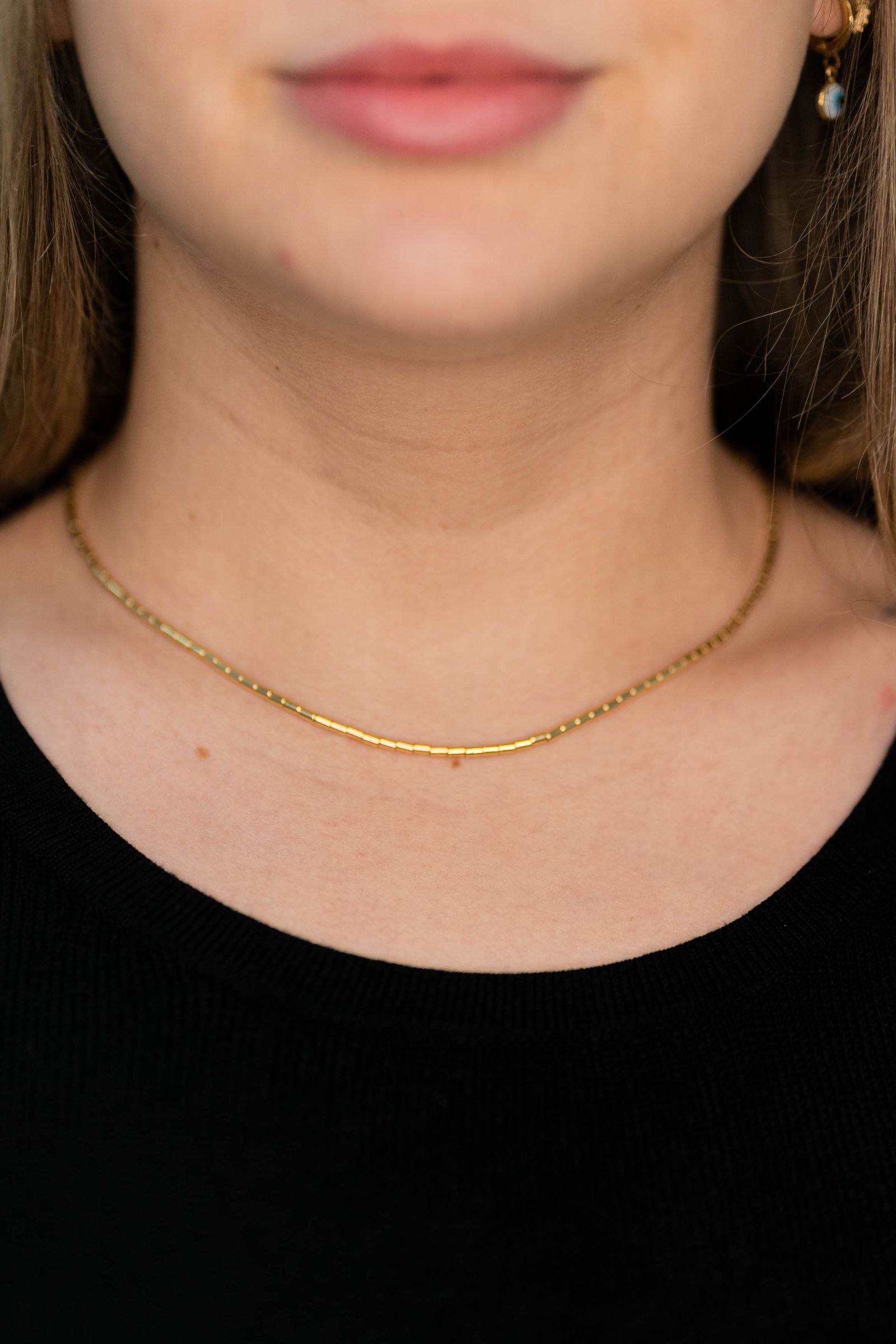
A necklace can look striking against a dark top and still feel inconvenient during an ordinary day. The chain may settle into the neckline, the pendant may tap a desk, or the fastening may be difficult to manage when you are already dressed. Treat contrast as the beginning of the decision rather than the whole decision. Use a top you actually wear, a familiar necklace and the light available at home. There is no universal chain length or metal colour that every dark outfit needs.
Establish the neckline you will wear
Put on the complete base layer before comparing jewellery. A round neckline, a shallow scoop and an open collar provide different areas for a chain to occupy. Check whether the edge stays in the same place when you sit and reach. A necklace that rests clearly above the fabric while standing may disappear under it at a table. If the top repeatedly catches the chain, choose another combination rather than spending the day arranging it between tasks.
A neat line can come from leaving a little visible space between necklace and neckline, or from deliberately letting a longer piece sit on the fabric. Neither arrangement is compulsory. What matters is that the relationship looks intentional to you and remains comfortable when the garment moves.
Compare contrast without buying another piece
Try the necklaces you already own one at a time. Against a dark background, a fine chain and a large pendant can create very different amounts of visible detail. Look from an ordinary conversational distance rather than judging only a close photograph. A piece that seems almost invisible beside the mirror may provide exactly the quiet finish you prefer across a room.
Use familiar daylight and your usual evening light. Changes in brightness and reflection can alter what stands out. These comparisons are observations about your own outfit, not proof of a jewellery material or its quality. Choose a finish because you enjoy the result, without assuming a particular colour has to suit everybody.
Check the resting position in motion
Sit in the chair you normally use and reach for a bag or notebook. Notice whether the pendant settles against a seam, slips inside the top or meets the edge of the table. Keep the check gentle; do not tug the chain to simulate wear. If a favourite necklace repeatedly shifts to an awkward place, save it for a different neckline instead of forcing it into this one.
An adjustable chain can offer another position when its design permits it. Check the maker's guidance and fastening rather than adding improvised extensions. A necklace that needs a new component is a separate practical decision from a necklace that merely needs another top.
Make the fastening part of the outfit check
Before leaving, confirm that the clasp is fully engaged and that any adjustable end is arranged as intended. A fastening you cannot operate comfortably may call for help or a different piece on a rushed morning. Practise with the item in a calm setting so that this does not become a last-minute experiment over an open sink.
If the clasp, chain or setting appears damaged, stop wearing the piece and ask an appropriate jeweller for advice. Styling cannot resolve a mechanical problem. Keep a suspected fault separate from ordinary movement of an intact chain, and avoid attempting a repair simply because a tool happens to fit.
Add the outer layer before deciding
Put on the cardigan, jacket or scarf that belongs to the actual day. Lapels can hide a pendant, knitwear can meet raised details, and a scarf can make the necklace unnecessary. You may prefer the jewellery only after removing the outer layer indoors. That is a useful arrangement if there is a sensible place for the scarf and no repeated catching while dressing.
Keep other accessories proportionate to the attention you want to give them. A decorative neckline and earrings may already provide enough detail. Leaving the necklace off is a complete styling choice, especially when wearing it creates more handling than pleasure.
Give the chosen piece a clear destination
Choose where the necklace will go when you take it off. Follow the item's care information and seek material-specific advice when needed; appearance alone does not establish a safe cleaning method. GIA's jewellery-care guidance is a useful starting point for understanding why storage and appropriate handling matter.
A known box or suitable pouch also makes the next outfit easier to assemble. Avoid leaving a small piece loose among dressing-table objects, where it can be overlooked or mistaken for part of another item. The storage arrangement should make it easy to identify the necklace without repeatedly untangling a group of chains.
Questions worth answering once
Must the pendant sit in the centre? Use its intended arrangement and your own preference; some designs are asymmetric. Does a dark top require a bright necklace? No, texture or a quiet finish may be enough. Should every accessory have the same finish? Compare the actual combination rather than applying a rule automatically.
The useful stopping point is an outfit that stays comfortable and feels finished without constant checking. Make a brief note of the top and necklace pairing if it works well. Next time, you can start from that known combination and adjust only the part of the day that has changed.
Continue the practical edit
Related reading: Adding Color Without Replacing Your Wardrobe, Getting Dressed for a Creative Office.
Sources & further reading
Official information checked October 15, 2026. This guide presents research-based editorial advice, not a claim of hands-on product testing. Event details and stock information reflect that check date.
Illustrative stock photograph by Wolf Art: photo source. This scene does not identify our author or establish a product test.


