
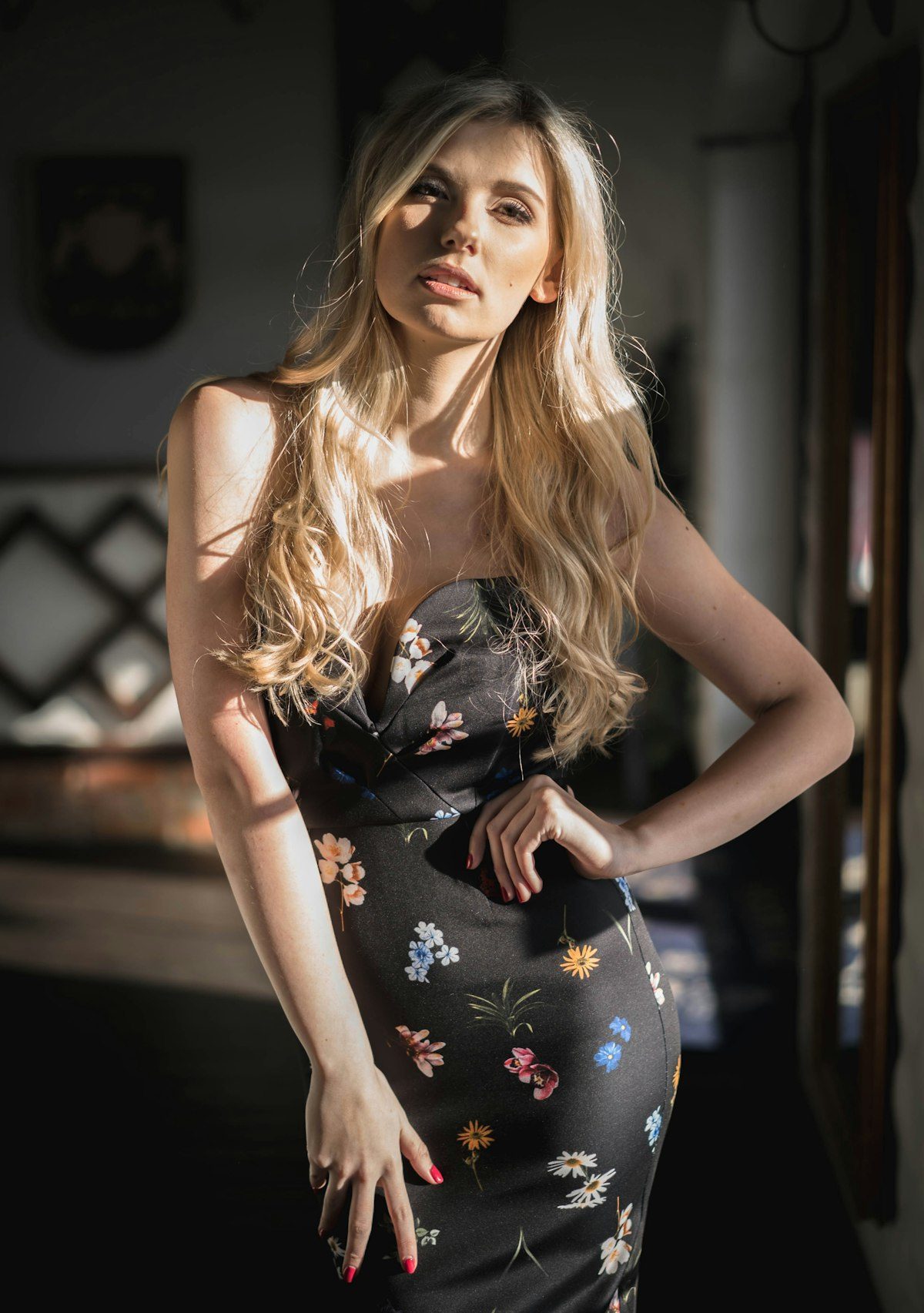
A floral dress often contains several possible colours for a cardigan or jacket, yet choosing one can make the outfit feel more complicated than wearing the dress alone. An exact match may be difficult to find, and the smallest colour in the print may look unexpectedly bright when repeated across a whole jacket. Start by separating colour from shape. First find a layer that is comfortable over the dress. Then use the print to compare the colours you already own, without treating it as a shopping list that must be completed.
Read the print at two distances
Hang the dress where you can see it clearly and look from across the room. Name the overall effect before studying individual flowers. It might read as a dark dress with scattered pale details, or as a pale dress with a lively mixture of colours. The background usually occupies more space than any single petal or leaf. A layer related to that background can create a quieter outfit, while one drawn from a small accent can make the whole combination feel much brighter.
Now look more closely and choose one accent that appeals to you. Suppose the dress has a dark ground, cream flowers and small green leaves. A dark cardigan may let the print remain central; a cream jacket may bring the lighter details forward; a muted green layer may emphasise the leaves. These are different effects rather than different levels of correctness. You can use a related colour already in the wardrobe without finding the precise shade printed on the fabric.
Establish a comfortable layer shape
Try the most practical layer before comparing colours. Check the dress straps or sleeves under it and move your arms as you would during the day. A jacket may sit neatly over a sleeveless dress but catch on a fuller sleeve. A cardigan may feel comfortable while leaving a neckline you do not like. Resolve those questions directly. Colour harmony cannot make an awkward sleeve arrangement pleasant, and an attractive photograph of a jacket does not show how it will fit over your particular dress.
Look at where the layer ends relative to the waist and skirt. A shorter cardigan can reveal more of a shaped waist; a long open layer can turn the print into a narrower central panel. If the dress has volume at the hips or a gathered skirt, notice whether the layer hangs freely or collects on top of it. Try the layer open and normally closed when both arrangements are comfortable. You may choose one clear way to wear it rather than expecting both versions to work equally well.
Compare a background colour and an accent
Put on the background-colour layer first and keep the shoes and bag unchanged. Look at the visible neckline, the central dress panel and the sleeve ends together. If the two dark colours are close but not identical, decide whether the difference bothers you in ordinary light. You do not need to reject a useful combination merely because the fabrics have different surfaces. A smooth dress and textured knit can create enough distinction to make neighbouring colours feel deliberate to you.
Try the accent-colour layer next. Notice the size of the new coloured area. A few cream flowers become a broad cream shoulder line when echoed in a jacket, while a small green leaf becomes a larger block in a cardigan. If the accent takes more attention than you wanted, try a softer version or return to the background colour. This is a useful reason to compare existing garments first: the print can inspire an experiment without obliging you to buy an exact matching piece.
Check what remains visible when you move
Walk, sit and reach while wearing the preferred combination. An open layer may shift and reveal more of the print at one side, which can be an appealing part of the outfit. A cardigan that you continually pull back to expose the dress may be the wrong shape for the effect you want. You can choose a different layer or accept a quieter view of the dress. Its full pattern does not have to remain on display from every angle for the combination to be worthwhile.
Check the shoes with the layer on. If both the jacket and shoes repeat the same small accent, the outfit may feel more coordinated than you prefer. A simpler familiar shoe can leave the coloured layer as the main addition. Conversely, a dark layer may give you room to enjoy a brighter shoe. Make one comparison at a time, and assess the complete arrangement with the bag you need. Its strap and shape will be present during the day even when they were absent from the initial mirror check.
Plan for the moment the layer comes off
Consider the dress on its own as well as with the jacket or cardigan. If you will remove the layer indoors, choose a bag and shoes you still enjoy with the underlying dress. You can also decide how the layer will be carried or put away, especially if it is bulky. That practical detail can change which otherwise pleasing option you choose. A favourite light cardigan may be easier for a changing day than a structured jacket that needs attention whenever you take it off.
Keep a small record of the successful pairing: the dress, the layer, whether it was open or closed, and the shoes. Add the colour relationship in plain words, such as dark background repeated in cardigan, or pale flower colour repeated at shoulders. This gives you a way to use the same method with another print later. Over time, a few understood relationships will be more useful than an expanding collection of almost-matching garments bought for individual flowers that nobody else needs to identify.
Related reading
What to Wear to a Backyard Celebration, Adding Color Without Replacing Your Wardrobe.
Editorial & photography notes
Practical editorial guidance for ordinary situations. This article does not claim product testing or report current offers. Follow the relevant maker’s instructions for the items you use.
Illustrative stock photograph by Karolis Milišauskas: photo source. This scene does not identify our author or establish a product test.


